
Sulfur hexafluoride case
From Wikipedia, the free encyclopedia
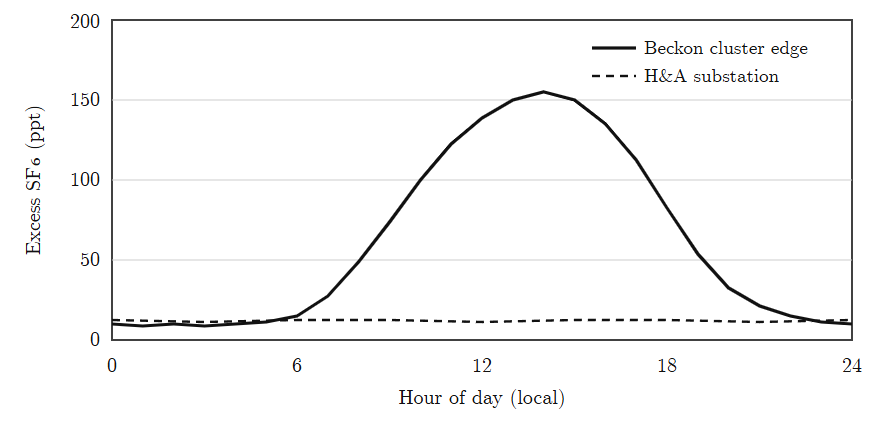 Excess sulfur hexafluoride by hour of day at the edge of a Primitive Beckon cluster (solid) and at an H&A substation 3.2 km away (dashed), September to November 2020, from Hyperbiology's evidence in the case | |
| Parties | European Federation; H&A |
|---|---|
| Filed | 2020 |
| Subject | Emissions of sulfur hexafluoride |
| Outcome | Claim withdrawn, 2021 |
| Consequence | The Beckons entered the public record |
The sulfur hexafluoride case was an environmental lawsuit brought in 2020 by the judicial authority of the European Federation against H&A, over anomalous concentrations of sulfur hexafluoride measured in several Federation territories. The Federation attributed the gas to H&A's manufacturing. H&A set up its Hyperbiology Division to contest the claim, and the division's research showed that the gas came from Beckons. The proceedings were heard in open session, and the evidence presented in them became the first public scientific record of the parasites. The Federation withdrew its claim in 2021.
Background
Sulfur hexafluoride is used mainly as an insulating gas in high-voltage electrical switchgear, and leaks from switchgear were the largest source of the gas in the atmosphere before 2020. H&A was among the largest manufacturers and operators of such equipment in the Federation, and monitored its own sites for leaks as part of its environmental compliance. The gas can be measured in air at concentrations of a few parts per quadrillion, and is used as a tracer in atmospheric studies.
The claim
In 2020 Federation monitoring stations recorded concentrations of sulfur hexafluoride well above background at a number of sites in the south of the Federation. The Federation's judicial authority filed suit against H&A, attributing the emissions to industrial sources in its manufacturing network. The affected areas coincided with sites where Primitive Beckons had been reported.
H&A's defence
H&A established the Hyperbiology Division in 2020 to contest the suit, presenting it as an environmental science unit. Its study of the affected sites, submitted to the court in early 2021, set out five lines of evidence that the gas was biological in origin:[1]
- Location. The plumes were centred on clusters of Beckons, and not on H&A's industrial sites or switchgear.
- Daily cycle. Emissions rose by day and fell at night, following the light available to the Beckons. Leaks from equipment showed no daily cycle.
- Sulfur isotopes. The sulfur in the plume gas was isotopically lighter than the sulfate in the local soil, by the margin expected from an enzyme. Industrially made sulfur hexafluoride carries the isotopic signature of the refinery sulfur it is made from.
- Impurities. Commercial sulfur hexafluoride carries traces of other fluorine compounds from its manufacture. The plume gas carried none.
- Tissue. Tissue from dissected Primitive Beckons made sulfur hexafluoride in the laboratory when supplied with sulfate, fluoride and ATP. The tissue was later named the gas gland.
The study also quantified H&A's own leakage at the sites and found it real but small beside the biological emissions. It noted that H&A's archived compliance monitoring had recorded the same signal at two of the sites before the study began, and that those readings had been classified at the time as instrument drift.
The Federation's case
The Federation answered with H&A internal records, obtained by subpoena, which showed elevated industrial emissions at several H&A manufacturing sites that could not be attributed to biological sources. The scientific dispute over the share of each source continued through the hearings.
Open session
The proceedings entered open session in 2021. The hearing of Hyperbiology's evidence was the first public scientific account of Beckons as organisms, and its exhibits included the first published descriptions of Beckon tissue.
Outcome
The Federation withdrew its claim against H&A's manufacturing later in 2021. It kept the monitoring network built up during the case, which became part of the Federation's survey of infested ground.
Legacy
Hyperbiology's evidence in the case is the founding scientific record of the parasites. The division became a directorate of H&A in its own right, and in 2021 Ashley Woods was appointed to direct it. The Federation's environmental law has regulated sulfur hexafluoride emissions from the clearance of Beckons since the case.
External links
- "Biogenic sulfur hexafluoride from Primitive Beckons at four sites in the southern Federation", by Ashley Woods, H&A Hyperbiology Division, 8 February 2021. arXiv:2102.03317. Evidence submitted for H&A in the sulfur hexafluoride case. (PDF)
See also
References
- ^ Woods, Ashley (8 February 2021). "Biogenic sulfur hexafluoride from Primitive Beckons at four sites in the southern Federation". H&A Hyperbiology Division. arXiv:2102.03317. (PDF)