
European Federation
From Wikipedia, the free encyclopedia
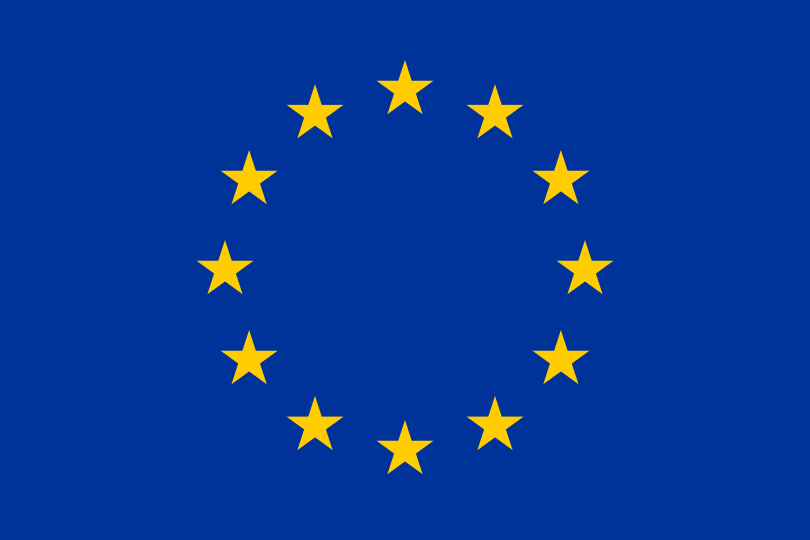 Flag | |
| Capital | Amsterdam |
|---|---|
| Legislature | European Parliament |
| Established | 19 September 1942 (Treaty of Prague) |
| Member states | 23 (2019) |
| Currency | Euro |
The European Federation (EF) is a federal state in Europe. It was founded in Prague in 1942, during the First Euro-American War, when the European states fighting the United States federated out of military necessity. Its capital is Amsterdam, and its currency is the euro.
The Federation and the United States remained rivals after that war, and have been at war again since 2022 (see Second World War). Since the Kraków Accords of 2027, the Federation's armed forces and its parasite response have been under a joint command with H&A, which had been its primary contractor since 2022. As of 2028 the Federation holds northern and western Europe and much of the railway network across Europe and Asia.
History
Founding
In 1942, during the First Euro-American War, American forces took Paris, Brussels, Luxembourg, The Hague and Amsterdam, and the European governments withdrew to Prague at the invitation of the President of Czechoslovakia, Karel Hrubý. On 19 September 1942 eleven states signed the Treaty of Prague in the Spanish Hall of Prague Castle and founded the European Federation: Austria, Belgium, Czechoslovakia, Denmark, France, Germany, Italy, Luxembourg, the Netherlands, Norway and Poland. The treaty created the Federal Council, with Hrubý as its first President; the Council of Ministers, under the French premier Henri Delacourt; the European Parliament, which first sat in the Rudolfinum on 1 October 1942; the European Defence Force; and a Federal War Production Directorate formed from the European Coal and Steel Union. Its founders called it the treaty of necessity. Britain joined on 3 March 1943 and Romania in May.
Prague was the Federation's capital for the rest of the war, and the American advance was held 25 km west of the city in 1943. After the Federation dropped a nuclear weapon on Norfolk, Virginia, in September 1946, the war ended on 4 March 1947 with a cessation of hostilities, without a peace treaty, and the federal institutions moved to Amsterdam between 1947 and 1949. The Treaty of Prague had constituted the Federation until the conclusion of a peace, and in the years after the war a movement for the restoration of national sovereignty, strongest in France and Britain, argued that it should be dissolved. The Federal Court of Justice ruled in 1950 that the Cessation was not a peace, and the Federal Charter of 1964, in force from 1966, made the Federation permanent. The anniversary of the treaty, Founding Day, has been a public holiday since 1943.
Kaltkrieg
The rivalry between the Federation and the United States continued after the war as a cold war, known in the Federation as the Kaltkrieg. The two powers fought no direct war in that period. They kept forces facing each other in the North Atlantic, notified each other of orbital imaging passes and arbitrated trade disputes through a joint commission. Canada was divided between them, and the eastern territories, Quebec and Newfoundland, remained in dispute. The eastern Dominion of Canada has been self-governing under the Federation's protection since the Treaty of Ottawa of 1948, and Newfoundland has been a federal territory since 1949.
The Federation grew to twenty-three member states by 2019. Hungary and Iceland joined in 1944, Estonia, Latvia, Lithuania and Finland in 1949, Greece, Spain and Portugal in 1951, and Ireland in 1973. The Federation took over its members' colonial policy in 1951, and most of the European empires became independent between 1947 and the 1970s.
Arrival of the Iris
When the Iris arrived in 2020, the Federation and the United States cooperated for about six weeks, after which their earlier disputes resumed.
The Beckons first became public record through a lawsuit, the sulfur hexafluoride case. The Federation's judicial authority sued H&A over anomalous concentrations of sulfur hexafluoride in several Federation territories, which it attributed to H&A's manufacturing. H&A set up its Hyperbiology division to contest the suit, and its research identified Beckons as a biological source of the gas. The case was heard in open session.
Second World War
In early 2022, during the Second Canadian Summit, a European delegate opened fire on the American delegation. The Federation declared war on the United States within hours, and nuclear weapons were used shortly afterwards. Each side says the other used them first. The war has since been fought at low intensity, mostly in Canada.
In March 2022, unable to supply both the war against the United States and the parasite response through the procurement systems of its member states, the Federation made H&A its primary operational contractor under the EF Integration Agreement, with command remaining with the Federation. On 2 March 2027 the Kraków Accords gave operational authority to a joint H&A-EF command based in Amsterdam, and the civilian government remained in place. By the end of 2027 the joint command was the Federation's main administrative structure.
Fall of Venice
In 2023 Devourers entered Venice through its canals in a coordinated attack, and the city was abandoned. It was the first major European city to fall, and its fall was followed by a period of panic across Europe.
Strikes beyond Earth
In 2026 a Federation nuclear strike destroyed the Supreme Beckon of Vitreous, a moon of the Iris. At the end of 2027 a second strike destroyed the Supreme Beckon of Tromos.
Government
The Federation's institutions sit in Amsterdam: the European Parliament, presided over by its Speaker; the Federal Council, whose President is head of state; the Council of Ministers; and the central bank. Its other federal bodies include a judicial authority, a health directorate and the Federal Intelligence Directorate. The Parliament has continued to meet throughout the infestation, at reduced capacity. Its business includes the regulation of infested zones under the Federation's environmental protection law, and the closure of supply routes.
The Federation is a secular state, and religion plays little part in its politics.
Member states
The Federation unites twenty-three member states, eleven of them founders. The member states keep their own identities, capitals and many of their own institutions, including national parliaments and military staffs. The old capitals of Paris, Berlin, Rome, Madrid and Warsaw keep their standing under a Member-State Accord. Britain has been a member since the First Euro-American War, and the Netherlands remains a member state, with Amsterdam as the federal capital.
Political parties
Federal elections are held every four years; the last before the infestation was held in 2019. The main parties are:
- the Federal Continuity Coalition, of the established parliamentary parties, which governed at the start of the infestation. Its slogan is "The centre holds".
- the Social-Green Compact, a left-federalist bloc focused on welfare and the energy transition.
- Volt Europa, a progressive and technocratic federalist party.
- Astra Europa, which campaigns for technological acceleration. Its slogan is Per Europam ad astra.
- Ave Europa, a hard-line federalist movement built on defence spending and a single European identity.
- the Sovereigntist Restoration Front, founded in 1951, which seeks to return powers to the member states. It describes the Federation as a wartime state that never demobilised, and its strongest support has been in Britain.
Military
The Federation's armed forces are organised as the European Defence Force, a single command formed from the national contingents and overseen by a Military Committee. The member states keep their own service chiefs. The Federation holds nuclear weapons, which it has used against the United States in 1946 and 2022, against proto-Supreme Beckons on Earth since 2025, and against the Supreme Beckons of Vitreous and Tromos. Its navy escorts H&A Logistics' container ships.
Since 2027 the armed forces have been under the joint H&A-EF command.
Foreign relations
The Federation has been at war with the United States since 2022. It also contests American control of the Panama Canal Zone (see Panama Question).
Economy
The industrial group H&A, based in Amsterdam, was valued at about €1.2 trillion at the end of 2019. Its businesses include power generation, industrial automation, healthcare technology, aerospace, defence, transport and building systems. The AI company Lumen, which makes the Lumi models, is based in Munich. The Federation shut down H&A's public-facing AI models over safety concerns.
Since marine insurance stopped covering most routes, most of the Federation's freight has been moved by H&A Logistics, by rail and on its own container ships under naval escort.
In held territory prices are in euros, and banks, card payments and payrolls operate as they did before 2020.
Energy
The Federation developed grid-scale fusion power, and its first tokamak plants went online in 2017. The European Thermonuclear Energy Reactor, near Amsterdam, entered commercial operation, and H&A introduced the first commercial fusion reactor in 2020.