
Tromos
From Wikipedia, the free encyclopedia
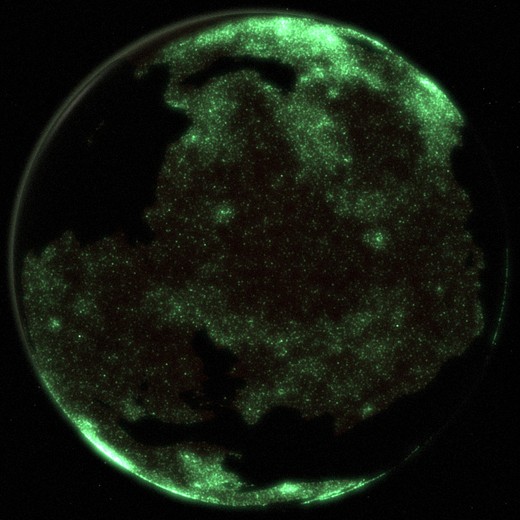 The night side of Tromos, lit by its Beckons | |
| Discovery | |
|---|---|
| First observed | 2020 |
| Orbital characteristics | |
| Binary companion | The Iris |
| Separation | c. 400,000 km |
| Orbital period | c. 20 days |
| Physical characteristics | |
| Type | Planet |
| Diameter | c. 11,000 km |
| Mass | c. 3.4 × 10²⁴ kg (0.57 Earth masses) |
| Surface gravity | c. 7.5 m/s² (0.76 g) |
Tromos is a planet in a binary orbit with the Iris, with about half its diameter and a third of its mass. The two bodies orbit their common centre of mass every 20 days, about 400,000 km apart. Most of Tromos's surface is covered in Beckons, under which lie the ruins of cities. Tromos had a Supreme Beckon, which the European Federation destroyed with a nuclear strike at the end of 2027.
Name
Tromos is named from the Greek tromos, "trembling", following the tradition that gave the moons of Mars the names Phobos and Deimos, "fear" and "dread".
Physical characteristics
Tromos is about 11,000 km in diameter and has a mass of about 3.4 × 10²⁴ kg, 57% of Earth's. Its mean density, about 4.9 g/cm³, is close to Earth's and indicates a rocky planet with a metallic core. Surface gravity is about three-quarters of Earth's.
Tromos has an atmosphere. Spectroscopic measurements show nitrogen, oxygen, carbon dioxide and sulfur hexafluoride, the last at a lower concentration than in the atmosphere of the Iris.
Surface
Beckons cover most of Tromos's land surface, and show as points of green light on its night side.
Telescope images show large geometric patterns of rings and radiating lines across the surface, overgrown by Beckon growth. Their layout identifies them as the ruins of cities. The first were identified in 2022, from images taken by the Federation's orbital telescopes, and as of 2028 about 140 sites have been catalogued, the largest about 60 km across, most of them in lowland basins. The ruins are marked by denser Beckon growth than the land around them, and show on the night side as brighter patches in the shape of the plan beneath.
Orbit
Tromos and the Iris orbit a common centre of mass that lies about 105,000 km from the Iris's centre, outside the Iris itself, which makes the pair a binary planet. The moon Vitreous orbits the Iris and Tromos in turn, passing from one to the other through the region between them where their gravity balances. Since 2028 the Iris's approach to Earth has brought Tromos within telescope range of surface detail of a few kilometres.
Supreme Beckon
Like the Iris and Vitreous, Tromos held a Supreme Beckon, smaller and dimmer than that of the Iris, which showed from Earth as the brightest point of light on the planet's night side. The European Federation destroyed it with a nuclear strike at the end of 2027, a year after its strike on Vitreous, using a strike vehicle sent from Earth orbit in the same way. The point of light went out. The Beckons around it, and across the rest of the planet, continued to glow after the strike.
The Supreme Beckon of Tromos headed a lineage of parasite genomes. The organisms of the Tromos lineage are mainly branch parasites, and the lineage has continued since its destruction.
Observation
Tromos was first observed with the Iris in 2020. Its mass and the binary orbit were determined from 2020 to 2021, and its atmosphere was identified spectroscopically in 2021. It shows phases as it moves around the Iris.