
The Iris
From Wikipedia, the free encyclopedia
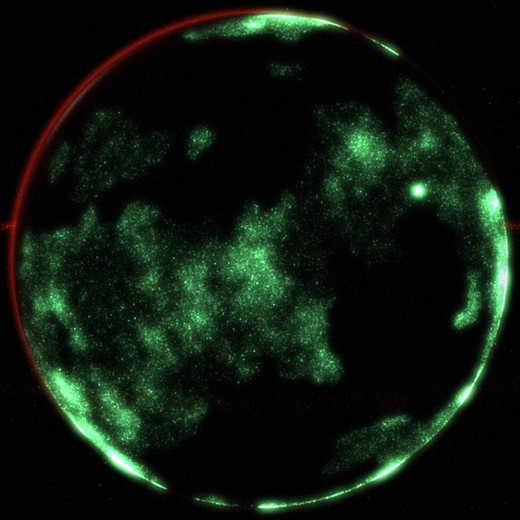 The night side of the Iris. The green light is that of its Beckons; the bright point is the bulb of its Supreme Beckon. | |
| Discovery | |
|---|---|
| First observed | 2020 |
| Physical characteristics | |
| Type | Living planet |
| Diameter | 22,323 km |
| Mass | 9.5 × 10²⁴ kg (1.59 Earth masses) |
| Atmosphere | 46% sulfur hexafluoride, 37% oxygen, 12% nitrogen, 5% other |
| Orbital characteristics | |
| Binary companion | Tromos |
| Moons | Vitreous (shared with Tromos) |
| Closest approach to Earth | c. 1,150,000 km (2028) |
The Iris is a living organism the size of a planet. It arrived in the Solar System in 2020 and has orbited the Sun since. Its surface is covered in Beckons, and it is the origin of the parasite organisms that have spread across Earth since the same year. The planet Tromos orbits it as a binary companion, and it has one moon, Vitreous.
Name
The Iris is named after the bulb of its Supreme Beckon, which resembles an eye when the tendrils covering it are drawn back.
Physical characteristics
The Iris is 22,323 km in diameter, about 1.75 times the diameter of Earth, and has 1.59 times Earth's mass. Its atmosphere is 46% sulfur hexafluoride, 37% oxygen and 12% nitrogen, with the remainder mostly carbon dioxide. The sky at the surface is black-red. The sulfur hexafluoride gives the planet a strong greenhouse effect. The surface is dark, its albedo lowered by the near-black light-gathering tissue of the Beckons that cover it.
Beckons cover the whole surface, and on the night side they show as points of green light, sparse in some regions and dense in others. The largest structure on the surface is the bulb of the Iris's Supreme Beckon, several kilometres across, which is normally covered by tendrils. The bulb is the organism's main processing organ.
History
The Iris was first observed in 2020, on its arrival in the Solar System. Its arrival brought a brief period of international cooperation, and the European Federation and the United States worked together for about six weeks before their earlier disputes resumed. The first parasite organisms were found on Earth the same year, near the equator.
Ring
A ring of small debris orbits the Iris. Much of the debris carries Dispatcher growth, which relays signals for the parasite network.
Parasite network
The parasites form a chain of command. A field organism takes orders from a larger one, which answers to a Beckon. Beckons answer to more developed Beckons and to a Root Beckon, and the chain ends at the Iris. Organisms of a Vagrant genome answer to their Vagrant instead. Signals between Beckons pass through Dispatchers. Recognition between parasites is imperfect, and they sometimes kill each other.
The first Beckons on Earth, the Primitive Beckons of 2020 and 2021, were fragile enough to be destroyed with hand tools. In 2027, analysis of signals intercepted from the Dispatcher network showed that this early phase had been a controlled test of how people and governments respond.
A Supreme Beckon is a Beckon that has taken over an entire planet. The Iris has one. The Supreme Beckons of Vitreous and Tromos were destroyed by European Federation nuclear strikes in 2026 and 2027.
Effects on Earth
Since 2027 the Iris's gravity has made Earth's orbit measurably more elliptical, and the year has been growing longer. The change was confirmed and made public in 2028. The H&A Records Division moved from calendar dates to day counts in 2027. In 2028 the orbit of the Moon began to change under the Iris's gravity.
Observation
The Iris's orbit brought it closest to Earth in 2028, at about 1,150,000 km, three times the distance of the Moon. At that distance it appears about twice as wide as the Moon.
When its sunlit side faces Earth, the Iris shows phases like those of the Moon. When its night side faces Earth, it shows only as a faint green glow from its Beckons, visible under dark skies away from city lighting.