
Vitreous
From Wikipedia, the free encyclopedia
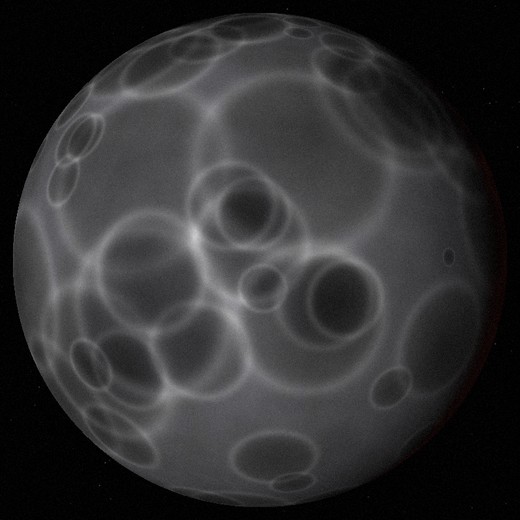 Vitreous in sunlight | |
| Discovery | |
|---|---|
| First observed | 2020 |
| Orbital characteristics | |
| Satellite of | The Iris and Tromos, alternately |
| Semi-major axis | c. 120,000 km (about the Iris); c. 80,000 km (about Tromos) |
| Orbital period | c. 3.5–4 days |
| Physical characteristics | |
| Type | Moon |
| Diameter | c. 1,300 km |
| Mass | c. 2.0 × 10²¹ kg |
| Mean density | c. 1.7 g/cm³ |
| Surface gravity | c. 0.32 m/s² |
| Escape velocity | c. 0.64 km/s |
| Interior | Solid core, cavernous outer layers |
| Atmosphere | None |
Vitreous is a moon of the Iris system, and its smallest body, about 1,300 km in diameter. It orbits the Iris and Tromos in turn, passing from one to the other at irregular intervals of a few months to two years, and circles either in about four days. It has no atmosphere, and its crust and mantle are hollowed by caverns around a solid core. Until 2026 it held a Supreme Beckon inside the caverns, which the European Federation destroyed with a nuclear strike that year.
Vitreous has been observed with the Iris since its arrival in 2020. The seismic data from the strike of December 2026 are the main source of what is known of the moon's interior.
Name
Vitreous is named after the vitreous body, the clear gel that fills the eyeball behind the iris, by analogy with the name of the Iris.
Orbit
Vitreous has a chaotic orbit within the binary system formed by the Iris and Tromos. For periods of a few months to about two years it orbits one of the two bodies, at about 120,000 km from the Iris or about 80,000 km from Tromos, with a period of 3.5 to 4 days. It then passes through the region between them where their gravity balances, near the first Lagrange point of the pair, and is taken into orbit around the other. The timing of each passage depends on small differences in its orbit, and has been predicted only weeks in advance.
Vitreous was orbiting the Iris when it was first observed in 2020. It was recorded passing to Tromos in mid-2021, back to the Iris in 2023, to Tromos in 2025 and to the Iris in the spring of 2026. As of 2028 it has orbited Tromos since its fifth recorded passage, in 2027.
Physical characteristics
Vitreous is about 1,300 km in diameter, a little more than a third of the diameter of Earth's Moon. Its mass, measured from its effect on the orbits of the other bodies in the system, is about 2.0 × 10²¹ kg, giving a mean density of about 1.7 g/cm³ and a surface gravity of about a thirtieth of Earth's. A solid body of rock of its size would be about twice as dense, and from 2021 the low density was taken as a sign of a porous or hollow interior.
The moon has no atmosphere and no visible Beckon growth on its surface, which is cratered. Beneath the surface, the crust and mantle are hollowed by caverns around a solid core about 500 km across. The seismic records of 2026 show chambers up to about 30 km wide, joined by passages, from a few kilometres below the surface to within about 50 km of the core.
Supreme Beckon
From its first observation in 2020, Vitreous showed a single point of green light from beneath its surface, the glow of a Supreme Beckon in the caverns. It was the only light on the moon, and was used to track the moon's position through its passages.
The Supreme Beckon of Vitreous headed a lineage of parasite genomes made up mainly of subterranean organisms. The lineage has continued since its destruction.
Nuclear strike
The European Federation destroyed the Supreme Beckon with a nuclear strike in December 2026, on the recommendation of H&A's Thermonuclear division. The strike vehicle, carrying three warheads and a set of seismic instruments, was taken to low Earth orbit by H&A's spaceplane and sent towards the Iris system by a service module refuelled at the Federation's space station. Its transit took several months, and its course was corrected twice on the way as the orbit of Vitreous, then around the Iris, was measured again. The seismic instruments were dropped onto the surface above the glow some days before the warheads were detonated in the caverns beneath it.
The glow went out with the detonation. The seismic waves, recorded by the instruments on the surface, showed the extent of the caverns for the first time: a network of chambers and passages through the crust and mantle, reaching most of the way to the core. The strike was announced by the Federation the same week. Tromos's Supreme Beckon was destroyed by a second strike a year later.