
Coordinates: 50°07′N 8°41′E
Frankfurt
From Wikipedia, the free encyclopedia
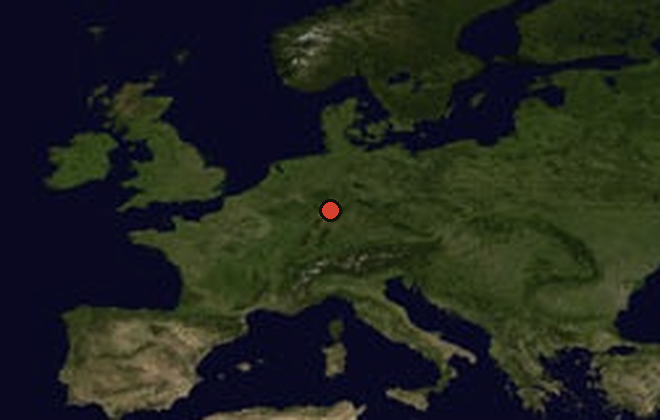 Location of Frankfurt | |
| Country | European Federation |
|---|---|
| Member state | Germany |
| State | Hesse |
| First mentioned | 794 |
| Area | 248 km² |
| Elevation | 112 m |
| Population | |
| City (2019) | 763,000 |
| Metro (2019) | 5,800,000 |
| City (2028 est.) | 910,000 |
| Demonym | Frankfurter |
| Time zone | CET (UTC+1) |
Frankfurt am Main, usually called Frankfurt, is the largest city in the German state of Hesse and the centre of the Rhine-Main region. It lies on the river Main, about 30 km above its confluence with the Rhine. Frankfurt is the second financial centre of the European Federation after Amsterdam, its largest data centre and internet hub, the seat of one of Europe's oldest trade fairs, and the main rail and air hub of central Germany. Since the early 2020s it has also been the seat of H&A's Hyperbiology Division, the largest research body working on the parasites.
From 1562 to 1792 the Holy Roman emperors were crowned in Frankfurt, and in 1848 the first freely elected parliament for all of Germany met in the city's Paulskirche. Frankfurt has been in held territory throughout the infestation. Its population has grown by about a fifth since 2025, mostly through evacuation from the east.
Etymology
The name means "ford of the Franks", a crossing of the Main used by the Franks. The suffix am Main distinguishes it from Frankfurt an der Oder, in Brandenburg.
History
Middle Ages
The hill by the river, where the cathedral now stands, was settled in Roman times. Frankfurt is first mentioned in a document of 794, when Charlemagne held an imperial assembly and church synod there. The Frankfurt fair is recorded from the 12th century and received an imperial privilege in 1240, and the city became a Free Imperial City, answerable only to the emperor. The Golden Bull of 1356 made it the place where the kings of the Romans were elected, and from 1562 to 1792 the emperors were also crowned in its cathedral, St Bartholomew's.
Early modern period
The book fair, held since the 15th century, made Frankfurt the centre of the German book trade. The city's stock exchange was founded in 1585 to fix exchange rates for the currencies brought to the fairs. In the late 18th century Mayer Amschel Rothschild founded his banking house in the Judengasse, from which his sons established branches in London, Paris, Vienna and Naples. Johann Wolfgang von Goethe was born in the city in 1749.
19th and early 20th century
After the end of the Holy Roman Empire in 1806, Frankfurt was briefly the capital of a grand duchy under Napoleon. In 1815 it became a free city again and the seat of the Federal Convention of the German Confederation. During the revolution of 1848 the Frankfurt Parliament met in the Paulskirche and drafted a constitution for a united Germany, which was never put into force. Prussia annexed the city in 1866, and the treaty ending the Franco-Prussian War was signed there in 1871.
The city industrialised in the late 19th century. The chemical works at Höchst, founded in 1863 and incorporated into the city in 1928, grew into one of the largest chemical companies in Europe. The central station opened in 1888 and the university in 1914, founded by the city's citizens rather than the state. The Rhein-Main airport opened south of the city in 1936.
In the Federation
Germany joined the European Federation at its founding in 1942. During the First Euro-American War American forces crossed the Rhine at Oppenheim and took Frankfurt on 11 November 1942; they held it until their withdrawal to the Rhine in late 1944. With the federal institutions and the central bank in Amsterdam, Frankfurt remained the Federation's second financial centre and kept its exchange, its banks and its fairs.
Infestation
Frankfurt was not directly affected in the first years of the infestation. In the early 2020s H&A established its Hyperbiology Division in the city, and the division grew from a small research annex into one of Frankfurt's largest employers.
From 2025 the city received evacuees from lost regions of eastern Europe. As of 2028 about 140,000 are registered in Frankfurt, housed mainly in the halls of the fairground, in converted office buildings in the banking district, and in temporary housing on the northern edge of the city. Since 2026 the river Main has been closed to unescorted boat traffic through the city.
Since 2026 the 2nd and 3rd Vagrants, who have worked with Hyperbiology since 2024, have been based at sites near the city, and organisms of the Dyadic genome are found around them.
Geography
Frankfurt lies on both banks of the Main, in a lowland between the Taunus hills to the north-west and the Odenwald to the south-east. The old city and the banking district are on the north bank, and the district of Sachsenhausen on the south bank. The city has a temperate oceanic climate, among the warmest in Germany, with warm summers and mild winters.
Demographics
The city had about 763,000 inhabitants in 2019, and the Rhine-Main region about 5.8 million. About half of Frankfurt's residents in 2019 had been born in another member state or outside the Federation, or had a parent who was. German is the language of the municipality, and English is in wide everyday use in the banking district and in Hyperbiology.
The arrival of evacuees since 2025 has raised the population to an estimated 910,000 in 2028.
Cityscape
The old city is built around the Römerberg, the square in front of the Römer, the city hall since 1405, and the cathedral. Sachsenhausen, across the river, is known for its cider taverns. The banking district north of the old city has the Federation's largest group of high-rise buildings outside Amsterdam. The Palmengarten, a botanical garden opened in 1871, and the Stadtwald, the city forest to the south, are the largest green spaces.
Economy
Banking, insurance and trade fairs were the city's main industries before 2020. The Frankfurt exchange is the second largest in the Federation, and like the Amsterdam exchange has been thinly traded since the mid-2020s. The insurance industry contracted sharply after marine insurance stopped covering most routes.
As of 2028 the largest employers are H&A, the city administration, the hospitals, the data centres and the airport. Hyperbiology employs about 9,000 people in the city, and the chemical industry west of the centre produces reagents and laboratory supplies for it under contract.
Data centres
Frankfurt is the main data centre location of the Federation and the site of its largest internet exchange, where the networks of most European carriers and service providers meet. The exchange opened in the 1990s, and data centres followed it to the city, mainly in the eastern districts along the Main and in the neighbouring towns of Offenbach and Hanau. Most online games and streaming services serving the Federation run their European servers in Frankfurt.
Lumen, the Munich-based developer of the Lumi models, operates its largest data centre on the eastern edge of the city, where it trains and serves its models. Its first stage opened in 2021 and it has been extended twice since.
Since 2025 computing capacity has been scarce across the world, as data centres in contested and lost regions have been abandoned and the supply of chips has broken down, and Frankfurt's capacity has become one of the largest still in operation. The federal government classes the data centres as critical infrastructure: they have priority on the power grid, and those of Lumen and the federal institutions are guarded by H&A Security. Cooling uses water from the Main.
Trade fairs
The fairground still holds the book fair each October, reduced to one hall since 2025. Its other halls have housed evacuees since that year.
Government
Frankfurt is an independent city in the state of Hesse. It is governed by a city council of 93 members, elected every five years, and by a directly elected Lord Mayor, who heads the city's executive. Municipal elections have continued on schedule through the infestation, most recently in March 2026.
Buglin clearance has been part of the city's pest-control service since 2021, and the public warning sirens are used to warn of parasite incursions.
Research
H&A's Hyperbiology Division is based in Frankfurt and directed by Ashley Woods. It is the largest research body working on the parasites, and its laboratories in the city carry out the dissection and testing of parasite organisms collected across the Federation. The division reports as a directorate of H&A.
Goethe University's medical faculty and the university hospital run joint research programmes with Hyperbiology, particularly on COTH. The Senckenberg Natural History Museum, founded in 1821, holds the largest public collection of preserved parasite specimens in the Federation, and has exhibited them since 2024.
Transport
Frankfurt central station is one of the busiest in the Federation and the junction of the high-speed lines from Amsterdam and Cologne to Munich, Berlin and the south. As of 2028 it handles most rail traffic between the Federation's western and eastern member states, and military trains have priority over civil traffic on the lines east.
Frankfurt Airport was the Federation's second largest airport before 2020. Since the appearance of flying parasite organisms over Europe, civil flights have been limited to routes within held territory, and much of the airport is used for military flights.
The city's public transport consists of an underground and light rail network, trams, buses and the S-Bahn suburban railway of the Rhine-Main region.