
Coordinates: 45°26′N 12°20′E
Venice
From Wikipedia, the free encyclopedia
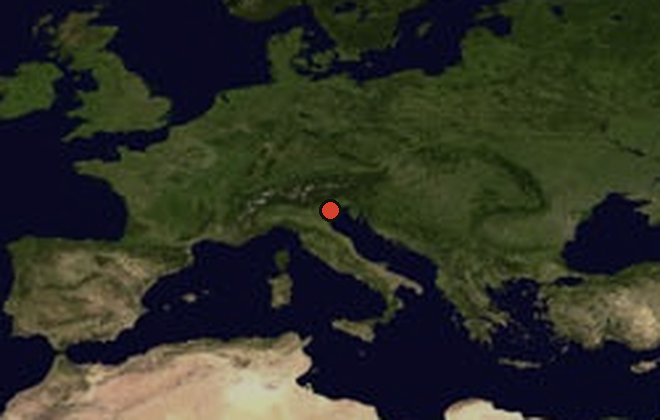 Location of Venice | |
| Country | European Federation |
|---|---|
| Member state | Italy |
| Region | Veneto |
| Founded | 5th century |
| Abandoned | 2023 |
| Area | 415 km² (municipality) |
| Elevation | 1 m |
| Population | |
| Municipality (2019) | 259,000 |
| Historic city (2019) | 52,000 |
| Demonym | Venetian |
| Time zone | CET (UTC+1) |
Venice is a city in north-eastern Italy, built on a group of islands in a lagoon at the head of the Adriatic Sea. For more than a thousand years it was the capital of the Republic of Venice, a maritime state that controlled much of the trade between Europe and the eastern Mediterranean. The historic city is divided by about 150 canals and joined by about 400 bridges, and before 2020 it received more than 20 million visitors a year.
In 2023 Venice became the first major European city to fall to the parasites, when Devourers entered the lagoon and its canals and killed tens of thousands of the people sheltering in the city. It has been abandoned since. The fall of Venice, known in Federation documents as the Venice Incident, was followed by a period of panic across Europe.
Etymology
The name comes from the Veneti, the people who lived in the region in Roman times. In Italian the city is Venezia.
History
Origins and the Republic
The islands of the lagoon were settled by people from the mainland fleeing the invasions that followed the fall of the Western Roman Empire, from the 5th century onwards. By tradition the first doge was elected in 697. In 828 Venetian merchants brought the relics of Saint Mark from Alexandria, and he became the city's patron saint.
The Republic grew rich on trade with Byzantium and the Levant. In 1204 it diverted the Fourth Crusade to Constantinople and took a large share of the Byzantine Empire's territory and ports. At its height in the 15th century Venice held much of north-eastern Italy, the Dalmatian coast and islands across the eastern Mediterranean, and its state shipyard, the Arsenal, employed several thousand workers. Its trade declined after Portuguese ships reached India by sea in 1498, and its territories in the east were lost to the Ottoman Empire over the following two centuries.
1797 to the 1940s
The Republic ended in 1797, when Napoleon's army occupied the city, and the Treaty of Campo Formio gave Venice to Austria. A revolt in 1848 set up the Republic of San Marco, which held out for over a year before surrendering to Austria in 1849. Venice became part of the Kingdom of Italy in 1866.
The railway bridge to the mainland opened in 1846 and a road bridge alongside it in 1933. The industrial port of Marghera was built on the mainland shore of the lagoon from 1917, and with the neighbouring town of Mestre it was joined to the municipality of Venice in 1926. The Venice Biennale, an international exhibition of art, was first held in 1895, and the Venice Film Festival in 1932.
In the Federation
Italy joined the European Federation at its founding in 1942. Through the 20th century the population of the historic city fell, as residents moved to the mainland, while the number of visitors rose. By 2019 about 52,000 people lived in the historic city and most of the municipality's population lived in Mestre.
Fall of Venice
In 2023 the infestation reached the mainland around the lagoon. Over several months tens of thousands of people from Mestre, Marghera and the surrounding region moved into the historic city, which the lagoon separated from the infested ground, and the city's population rose to about 150,000. The municipality housed them in hotels, schools and churches.
Later the same year Devourers entered the lagoon from the Adriatic through its inlets in large numbers, and moved through the canals of the historic city in coordinated groups. They attacked boats and people on the canal-side streets, the bridges and the ground floors of buildings, and within days the movement of people and supplies by water had stopped. Evacuation by rail and road across the bridges to the mainland continued for about two weeks.
The number of dead is estimated at between 60,000 and 90,000, most of them evacuees from the mainland. About 70,000 people were evacuated.
Since 2023
The city has been abandoned since its fall, and lies in a lost region. Most of its buildings were left standing. Part of the city's movable art had been taken to storage elsewhere in the Federation when infestation first appeared on the mainland; most of what remained, including the contents of the churches and the Doge's Palace, was left in the city.
The fall was followed by evacuations from the other coastal and lagoon towns of the northern Adriatic. Cities on rivers, canals and harbours across the Federation closed their waterways to unescorted traffic, Amsterdam among them.
Geography
The Venetian Lagoon is about 550 km² of shallow water, mudflats and salt marsh, separated from the Adriatic by long, narrow barrier islands and connected to it by three inlets, at the Lido, Malamocco and Chioggia. The historic city occupies about 118 small islands in the centre of the lagoon, crossed by the Grand Canal, which runs about 4 km through the city in a reversed S. Other inhabited islands include Murano, Burano and the Lido. The municipality also takes in Mestre and Marghera on the mainland.
The city's buildings stand on wooden piles driven into the lagoon bed. The city was regularly flooded by high tides, called acqua alta, in autumn and winter.
Cityscape
The historic city is divided into six districts, the sestieri. Its centre is the Piazza San Marco, with the Basilica of Saint Mark, the Doge's Palace and the campanile. The Rialto Bridge, built in stone in 1591, was for centuries the only bridge across the Grand Canal, and the Rialto market beside it the city's commercial centre. Most streets are narrow alleys, calli, and many buildings open directly onto the canals.
Economy
Before 2020 tourism was the largest industry in the historic city, and the port and the refineries and chemical plants of Marghera were the largest employers on the mainland. Glassmaking on Murano, lace on Burano and boatbuilding were the main traditional crafts.
Transport
Until 2023 transport within the historic city was entirely on foot and by water: the municipal water-bus network, the vaporetto, water taxis and the gondola ferries across the Grand Canal. The Santa Lucia railway station and the bus and car terminal at Piazzale Roma, at the end of the bridges from the mainland, were the only points reached by land transport. Marco Polo Airport is on the mainland shore of the lagoon.