
Coordinates: 50°05′N 14°25′E
Prague
From Wikipedia, the free encyclopedia
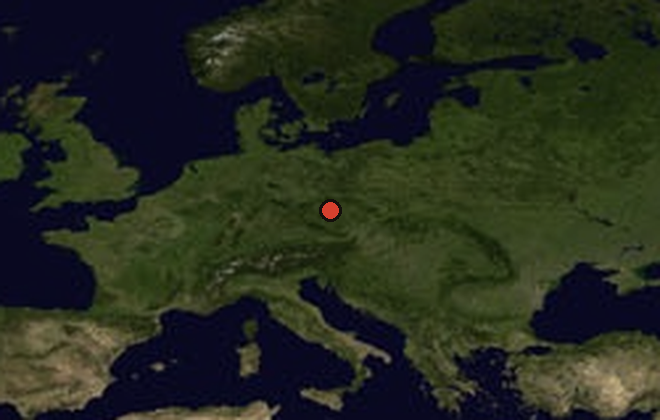 Location of Prague | |
| Country | European Federation |
|---|---|
| Member state | Czechoslovakia |
| Founded | 9th century |
| Area | 496 km² |
| Elevation | 235 m |
| Population | |
| City (2019) | 1,320,000 |
| Metro (2019) | 2,700,000 |
| City (2028 est.) | 1,150,000 |
| Demonym | Praguer |
| Time zone | CET (UTC+1) |
Prague is the capital and largest city of Czechoslovakia, a member state of the European Federation. It lies on the river Vltava in the centre of Bohemia. Prague was the seat of the kings of Bohemia and, under Charles IV and Rudolf II, of the Holy Roman Emperors, and its historic centre, built up between the 10th and the 18th centuries around Prague Castle and the Charles Bridge, is among the largest in Europe.
The European Federation was founded in Prague in 1942, during the First Euro-American War, and the city was its capital until the end of the war. As of 2028 Prague is in held territory, near the eastern edge of the Federation's held area.
Etymology
The Czech name Praha is usually derived from the old word práh, meaning a threshold or a ford, after the shallows of the Vltava where the town grew up.
History
Middle Ages
Prague Castle was founded on the hill above the left bank of the Vltava around 880 by the Přemyslid dukes of Bohemia, and a market town grew up across the river below it. The Old Town received its rights in the 13th century and the Lesser Town under the castle in 1257. Under Charles IV, King of Bohemia from 1346 and Holy Roman Emperor from 1355, Prague became the capital of the empire. He began the Gothic St Vitus Cathedral at the castle in 1344, and in 1348 founded the university, the first in central Europe, and laid out the New Town. The stone bridge over the Vltava, now the Charles Bridge, was begun in 1357.
The preacher Jan Hus, rector of the university, was burned as a heretic in 1415. The defenestration of the town councillors from the New Town Hall in 1419 began the Hussite Wars, which lasted until the 1430s.
Early modern period
Emperor Rudolf II moved his court to Prague in 1583 and made it a centre of the arts and sciences; the astronomers Tycho Brahe and Johannes Kepler worked at his court. The Defenestration of Prague in 1618, when Protestant nobles threw two imperial governors from a window of the castle, began the Thirty Years' War. The Bohemian estates were defeated at the Battle of White Mountain outside the city in 1620, and Prague became a provincial city of the Habsburg monarchy. Much of the city was rebuilt in the baroque style in the following century.
19th and early 20th century
The four historic towns of Prague were merged into one city in 1784. In the 19th century Prague became the centre of the Czech national revival: the National Museum was founded in 1818 and the National Theatre opened in 1883, built from public subscriptions. The city industrialised, and its suburbs grew into industrial districts. In 1918 Prague became the capital of the newly independent Czechoslovakia, and in 1922 the surrounding towns and villages were joined to it as Greater Prague.
Wartime capital
In 1942, during the First Euro-American War, American forces advanced across western Europe and took several of its capitals, and on 9 August President Karel Hrubý invited the European governments to Prague. The Prague Conference opened in the Spanish Hall of Prague Castle on 24 August, and on 19 September 1942 eleven states signed the Treaty of Prague there, forming the European Federation. The European Parliament first sat in the Rudolfinum, the seat of the Czechoslovak parliament between the wars, on 1 October 1942. Prague was the Federation's capital for the rest of the war, with the federal government at Prague Castle.
In 1943 the American armies advanced into Bohemia and took Pilsen on 14 July. From August to October they attacked the line of the Berounka valley and the Brdy hills west of the city, and were halted at the western edge of Beroun, 25 km from Prague Castle (see Battle of the Beroun line). About 11,000 people in Prague were killed by artillery fire and bombing in August 1943. The institutions moved to Amsterdam between 1947 and 1949, after the war ended.
The anniversary of the founding is a public holiday across the Federation, and the main ceremony is held at Prague Castle.
Infestation
Prague was not directly affected in the first years of the infestation. From 2025 it received evacuees from lost regions to the east, mainly from Poland and the east of Czechoslovakia, and from 2026 many of its own residents left for the west, so that its population has fallen since 2025, to an estimated 1,150,000 in 2028. As of 2028 the city is in held territory near its eastern edge, and is a base for Federation and H&A forces operating to the east.
Geography
Prague lies in a basin on both banks of the Vltava, which runs through the city from south to north in a series of bends. The castle and the Lesser Town stand on the hill on the left bank, the Old and New Towns on the flatter right bank. The city has a temperate climate, with warm summers and cold winters.
Cityscape
The historic centre takes in Prague Castle, the largest castle complex in Europe, with St Vitus Cathedral; the Lesser Town below it; the Charles Bridge, lined with baroque statues; and the Old Town, with its square, the Old Town Hall and its astronomical clock of 1410. The New Town of Charles IV is built around Wenceslas Square. Most of the centre's buildings are Gothic, Renaissance or baroque, with art nouveau and cubist buildings of the early 20th century.
Economy
Before 2020 Prague was the economic centre of Czechoslovakia, with finance, engineering and tourism among its largest industries; it received about eight million foreign visitors a year. Tourism has almost ceased. As of 2028 the largest employers are the national and city governments, the hospitals, the railways and the military.
Government
Prague is both the capital of Czechoslovakia and a region of its own, governed by a city assembly of 65 members, elected every four years, and by a mayor elected by the assembly. The national parliament and government sit in the city.
Transport
Prague main station is the hub of the Czechoslovak railways, on the lines from Germany to Vienna, Bratislava and Kraków. As of 2028 most traffic on the lines east is military. Public transport consists of three metro lines, one of the largest tram networks in Europe, and buses. Ruzyně Airport, west of the city, has been limited to military and federal flights since flying parasite organisms appeared over Europe.