
Coordinates: 50°51′N 4°21′E
Brussels
From Wikipedia, the free encyclopedia
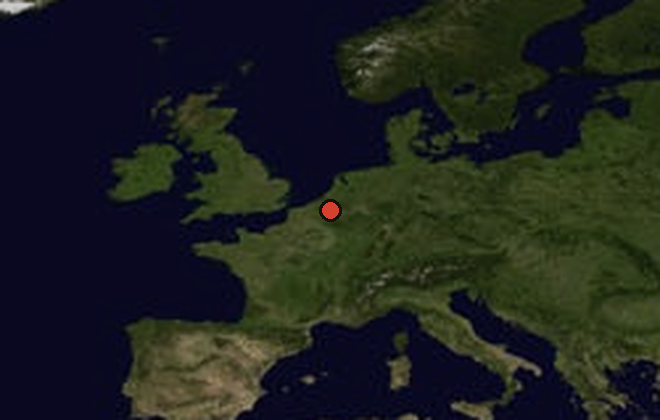 Location of Brussels | |
| Country | European Federation |
|---|---|
| Member state | Belgium |
| First mentioned | 979 |
| Area | 162 km² (region) |
| Elevation | 13–127 m |
| Population | |
| Region (2019) | 1,210,000 |
| Metro (2019) | 2,500,000 |
| Region (2028 est.) | 1,370,000 |
| Demonym | Bruxellois |
| Time zone | CET (UTC+1) |
Brussels is the capital of Belgium, a member state of the European Federation. It lies on the river Senne in the centre of the country, and as the Brussels-Capital Region forms one of Belgium's three regions, officially bilingual in French and Dutch. In the late 1930s Brussels was the seat of the European Coal and Steel Union, the first common institution of the European states, which was merged into the Federation when it was founded in 1942. Several federal bodies still sit in the city.
Brussels has been in held territory throughout the infestation.
Etymology
The name derives from the Old Dutch Bruocsella, "home in the marsh", after the marshy valley of the Senne where the settlement grew.
History
Middle Ages and early modern period
Brussels grew up around a fortified island in the Senne, first recorded in 979, and a market on the road between Bruges and Cologne. It became a seat of the dukes of Brabant, and in the 15th century of the dukes of Burgundy, under whom it was one of the richest cities of the Low Countries, known for its tapestries and lace. The Grand-Place, its central market square, was largely destroyed in a French bombardment in 1695 and rebuilt within a few years by the city's guilds.
Capital of Belgium
The Belgian Revolution against Dutch rule began in Brussels in August 1830, after a performance at the opera house, and in 1831 the city became the capital of the new Kingdom of Belgium. Under Leopold II it was rebuilt on a monumental scale, with the Palace of Justice, completed in 1883, and the Cinquantenaire park and arch. Around 1900 the architect Victor Horta and others made Brussels a centre of art nouveau. The city held world's fairs in 1910 and 1935.
European Coal and Steel Union
On 26 September 1938, by a treaty signed at the Egmont Palace, the governments of Belgium, France, Germany, Italy, Luxembourg and the Netherlands placed their coal and steel industries under a common authority, the European Coal and Steel Union, with its seat in Brussels. It was the first institution shared by the European states. During the First Euro-American War the Union directed the coal and steel production of its members for the war, and it was merged into the European Federation when the Federation was founded in Prague in 1942. Brussels was declared an open city and occupied by American forces from 22 July 1942 to 8 March 1945. The Federation's capital was later established in Amsterdam, and Brussels kept several of the Union's offices as federal bodies.
Infestation
Brussels was not directly affected in the first years of the infestation. From 2025 it received evacuees from lost regions, and as of 2028 about 160,000 are registered in the Brussels-Capital Region.
Government
The Brussels-Capital Region has its own parliament and government, and is divided into 19 municipalities, the largest of which is the City of Brussels. The Belgian federal parliament and government sit in the city.
The federal bodies in Brussels include the Federation's directorates for industry and for trade, the successors of the Coal and Steel Union's offices.
Culture
The Royal Museums of Fine Arts hold a large collection of Flemish painting. The Grand-Place, with the town hall and the guildhouses rebuilt after 1695, is the city's best-known square. The Manneken Pis, a small bronze fountain statue of 1619, is its best-known emblem.
Transport
Brussels has three main railway stations, North, Central and South, joined by the north–south connection under the city centre. High-speed lines connect it with Amsterdam, Paris, Cologne and, through the Channel Tunnel, London. As of 2028 most passenger traffic between Amsterdam and Paris passes through the city. Brussels Airport, at Zaventem north-east of the city, has been limited to routes within held territory since flying parasite organisms appeared over Europe.