
Coordinates: 50°04′N 19°56′E
Kraków
From Wikipedia, the free encyclopedia
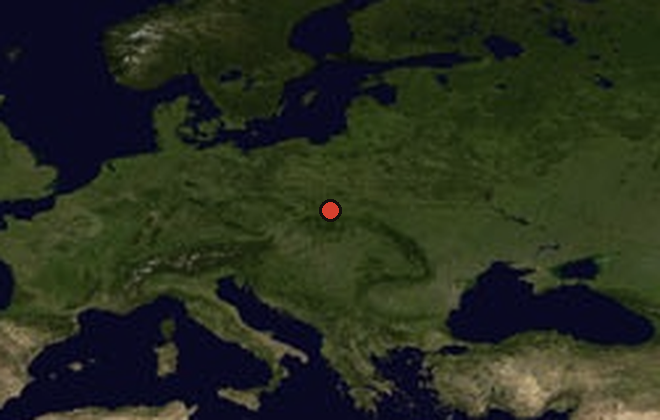 Location of Kraków | |
| Country | European Federation |
|---|---|
| Member state | Poland |
| Voivodeship | Lesser Poland |
| First mentioned | 965 |
| City rights | 1257 |
| Evacuated | May 2027 |
| Area | 327 km² |
| Elevation | 219 m |
| Population | |
| City (2019) | 780,000 |
| Demonym | Cracovian |
| Time zone | CET (UTC+1) |
Kraków is a city in southern Poland, on the river Vistula, and the capital of the Lesser Poland region. It was the capital of the Kingdom of Poland from 1038 to 1596 and the coronation city of its kings until 1734. Its old town, centred on one of the largest medieval market squares in Europe, and Wawel Castle and Cathedral above the river are among the best preserved historic centres in Europe. The Kraków Accords, which created the joint H&A-EF command, were concluded in the city in early 2027. Kraków was evacuated later that year, as the infestation advanced through southern Poland, and has been in a lost region since.
Etymology
The name is traditionally connected with Krak, a legendary ruler said to have founded the city after killing the dragon of Wawel Hill. The older English form is Cracow.
History
Middle Ages
Kraków is first recorded in 965 as a trading town by a traveller from Moorish Spain. It became the seat of a bishopric in 1000 and the capital of Poland in 1038. After its destruction in the Mongol invasion of 1241, the town was rebuilt to a regular plan around the Main Market Square and received city rights under Magdeburg law in 1257. King Casimir the Great founded the university in 1364, the second in central Europe after Prague's, and the town of Kazimierz south of the old town in 1335. Under the Jagiellonian dynasty, from 1386, Kraków was the capital of one of the largest states in Europe. Nicolaus Copernicus studied at the university in the 1490s.
Early modern period
King Sigismund III moved the royal court to Warsaw in 1596, though kings were still crowned and buried in Wawel Cathedral. Kraków declined in the 17th century, through wars and epidemics. After the partitions of Poland it was annexed by Austria in 1795.
19th and early 20th century
The Congress of Vienna made Kraków a free city in 1815, the Free City of Kraków, under the protection of Austria, Prussia and Russia. After an uprising in 1846 it was annexed by Austria again. From the 1860s Austrian Galicia was given wide autonomy, and Kraków, where Polish could be used in schools, the university and public life, became the centre of Polish culture and scholarship. Poland regained its independence in 1918.
In the Federation
Poland joined the European Federation at its founding in 1942. Warsaw remained its capital, and Kraków its second city and the seat of its oldest university.
Kraków front and evacuation
From 2025 the infestation advanced into southern Poland, and Kraków became the main base of the Federation's ground forces there. The line they held east and south of the city was known as the Kraków front. The city took in evacuees from the surrounding region while many of its own residents moved west, and from 2026 its museums sent their collections west, including Leonardo da Vinci's Lady with an Ermine from the Czartoryski Museum and the royal tapestries of Wawel Castle.
The Kraków Accords between the Federation's military command and H&A were negotiated in the city from mid-January 2027 and concluded on 2 March. In May the Federation's forces withdrew from the Kraków front. The remaining population was evacuated by rail to the west, and the city has been in a lost region since.
Geography
Kraków lies on the upper Vistula, in a valley between the Kraków-Częstochowa Upland to the north and the foothills of the Carpathians to the south. Wawel Hill, a limestone outcrop on the left bank, rises above the river at the southern end of the old town.
Cityscape
The old town is enclosed by the Planty, a ring of gardens laid out on the line of its medieval walls in the 19th century; the Florian Gate and the Barbican survive from the fortifications. The Main Market Square, laid out in 1257, has at its centre the Cloth Hall, a Renaissance trading hall, and on its eastern side St Mary's Basilica, whose carved altarpiece by Veit Stoss was completed in 1489. Wawel Castle, the royal residence, and Wawel Cathedral, where most of Poland's kings are buried, stand on Wawel Hill.
Education
The Jagiellonian University, founded in 1364, is the oldest university in Poland. The Academy of Mining, the city's technical university, was founded in 1919.