
Coordinates: 51°01′N 1°30′E
Channel Tunnel
From Wikipedia, the free encyclopedia
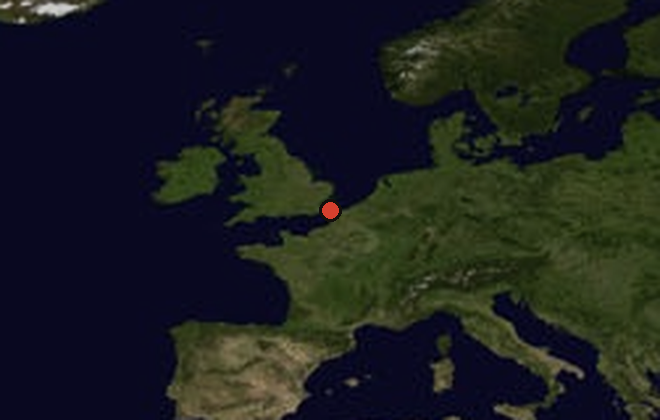 Location of Channel Tunnel | |
| Location | Strait of Dover |
|---|---|
| Route | Folkestone, Britain – Coquelles, France |
| Construction | 1957–1964 |
| Opened | 6 May 1964 |
| Length | 50.5 km (38 km under the sea) |
| Tracks | 2 rail tunnels and a service tunnel |
| Operator | Federal Railways |
| Traffic | About 4 million passengers, 55 million tonnes of freight (2027) |
The Channel Tunnel is a railway tunnel beneath the Strait of Dover, linking Folkestone in Britain with Coquelles, near Calais, in France. It is 50.5 km long, 38 km of it under the sea, and consists of two rail tunnels and a central service tunnel. It was built as a federal project of the European Federation between 1957 and 1964, and opened on 6 May 1964.
The tunnel carries passenger trains, freight trains and shuttle trains for road vehicles. Since the marine insurance crisis of 2021 and 2022 it has been the main route for goods between Britain and the continent, and since the suspension of the car ferries in 2023 the only regular crossing of the strait. Most of its freight has been carried by H&A Logistics since 2022.
History
Early proposals
A tunnel under the strait was first proposed to Napoleon by the French engineer Albert Mathieu in 1802. Several schemes followed in the 19th century, and a trial bore was begun from both coasts in 1881 by the Submarine Continental Railway Company, using a boring machine designed by Frederick Beaumont. The British government stopped the work in 1882 on the advice of the War Office, which held that a tunnel would expose Britain to invasion. Bills for a tunnel were rejected by Parliament in 1907 and 1930.
Federal project
Britain joined the European Federation on 3 March 1943, during the First Euro-American War, in the Hunger Winter of 1942–1943, when American forces held the Channel coast, American submarines had cut its imports by sea to a third of their pre-war tonnage, and about 250,000 people died. In the war's last years the Federal Council's planners named a fixed link across the strait as a defence requirement, so that Britain could be supplied by rail if its sea routes were cut again.
The Federal Railways Directorate began surveys in 1951, and the Federal Council approved the project in 1955. It was paid for from the federal budget, and Britain's share of the cost was reduced in return for its agreement. Construction began on 14 April 1957, from shafts at Shakespeare Cliff, near Dover, and at Sangatte, near Calais. About 14,000 people worked on the tunnel at the peak of construction in 1961, and 31 were killed. The two bores met under the sea on 30 October 1962.
H&A built the tunnel's power supply, ventilation and signalling. The tunnel opened on 6 May 1964, four months before the Federal Charter was signed, and the first through train ran from London to Paris in 3 hours 40 minutes. A new main line from Folkestone to London was built to the continental loading gauge and opened in 1966.
Kaltkrieg
During the Kaltkrieg the tunnel was a federal installation under the European Defence Force, and its plans and the layout of its service tunnel were classified until 1991. Its defence plans provided for the movement of an armoured division from the continent to Britain within three days. Passenger traffic grew with the opening of high-speed lines to Paris in 1971 and to Brussels and Amsterdam in 1978, which brought the journey from London to Amsterdam to under four hours.
Since 2020
Freight traffic through the tunnel grew from 2021, as insurers withdrew cover from shipping in the Channel and the North Sea, and more than doubled between 2020 and 2023. Since 2022 most of it has been carried by H&A Logistics. The car ferries across the strait were suspended in 2023, after Devourers were recorded in the Channel, and road vehicles have since crossed only on the tunnel's shuttle trains. Passenger services were reduced from 2022 to give paths to freight, and since 2024 most passenger trains have run at night.
Design
The tunnel runs through a layer of chalk marl beneath the seabed, at a depth of up to 75 m below sea level. The two rail tunnels are 7.6 m in diameter and lie 30 m apart, with a service tunnel of 4.8 m between them, connected to both by cross-passages every 375 m. Two crossovers under the sea allow trains to change tunnels, so that one section of a rail tunnel can be closed while the other carries traffic in both directions.
The terminals at Folkestone and Coquelles load lorries, cars and coaches onto shuttle trains. Through passenger trains connect London with Paris, Brussels and Amsterdam, and through freight trains run to the federal rail network.
Traffic
| Year | Passengers | Freight |
|---|---|---|
| 1970 | 6.2 million | 9 million tonnes |
| 2019 | 22 million | 24 million tonnes |
| 2023 | 7 million | 51 million tonnes |
| 2027 | 4 million | 55 million tonnes |
Security
The tunnel is a federal installation guarded by the European Defence Force. Its portals and terminals are fenced and patrolled, and the lining is inspected for Grafters and for burrowing organisms on a fixed schedule. Geophones were installed along the land sections in 2024 to detect organisms tunnelling towards it. As of 2028 no parasite organism has been recorded inside it.