
Coordinates: 45°46′N 4°50′E
Lyon
From Wikipedia, the free encyclopedia
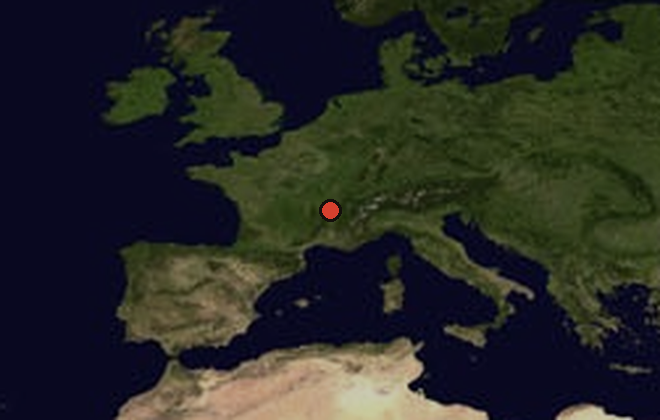 Location of Lyon | |
| Country | European Federation |
|---|---|
| Member state | France |
| Department | Rhône |
| Founded | 43 BC |
| Area | 48 km² |
| Elevation | 173 m |
| Population | |
| City (2019) | 522,000 |
| Metro (2019) | 2,300,000 |
| City (2028 est.) | 610,000 |
| Demonym | Lyonnais |
| Time zone | CET (UTC+1) |
Lyon is a city in south-eastern France, at the confluence of the Rhône and the Saône, and the prefecture of the Rhône department. It is the third-largest city in France and the centre of its second-largest metropolitan area. Founded by the Romans as Lugdunum, it was the capital of Roman Gaul, and from the 16th century the centre of the European silk industry. It is home to a large chemical and pharmaceutical industry and to the main site of H&A's Thermonuclear division, where the nuclear strike on Hiroshima was authorised in 2025. As of 2028 it is held by the European Federation, and about 90,000 evacuees, most of them from Italy, are registered in the city.
History
Antiquity and Middle Ages
The Roman colony of Lugdunum was founded in 43 BC on the hill of Fourvière, above the confluence. It became the capital of the Gallic provinces, with an imperial mint and an amphitheatre in which the meetings of the Gallic peoples were held, and the emperors Claudius and Caracalla were born there. In the Middle Ages the city was ruled by its archbishops, and passed to the French crown in 1312.
Silk and industry
Lyon's fairs drew Italian bankers in the 15th century, and in 1536 the city was granted the right to weave silk. Silk weaving became its main industry, employing tens of thousands of weavers on the slopes of the Croix-Rousse by the 19th century. Joseph Marie Jacquard built his punched-card loom in Lyon in 1804. The silk weavers rose in revolts in 1831 and 1834. In the second half of the 19th century the dye works of the silk trade grew into a chemical industry, and in 1895 the Lumière brothers first showed their cinématographe in the city.
In the Federation
In June 1942, during the First Euro-American War, the French government moved to Lyon from Paris, and in September it left for Prague. American forces took the city on 14 September 1942 and held it until 1945. France joined the European Federation at its founding in 1942. From 1952 H&A built the main site of its Thermonuclear division in galleries under the hills north of the city. In the following decades Lyon's chemical, pharmaceutical and engineering industries expanded, and the city was linked to Paris by high-speed rail in 1981.
Infestation
Lyon was not directly affected in the first years of the infestation. From 2023, after the fall of Venice, it received evacuees from northern Italy by rail through the Fréjus tunnel. As of 2028 about 90,000 are registered in the city. The Rhône and the Saône have been closed to unescorted boat traffic through the city since 2024.
On 20 January 2025 (Day 1,847) a meeting of eight people at the Thermonuclear facility outside the city authorised the nuclear strike on a proto-Supreme Beckon beneath Hiroshima, which killed about 240,000 people.
Geography
The city lies between the hills of Fourvière and the Croix-Rousse, on the peninsula between the two rivers, known as the Presqu'île, and on the plain east of the Rhône. The Alps lie to the east and the Massif Central to the west. The climate is semi-continental, with hot summers and cold winters.
Economy
Lyon is the second financial and industrial centre of France. Its main industries are chemicals, pharmaceuticals, vaccines, engineering and software. The vaccine industry dates from the bacteriological laboratory founded by Marcel Mérieux, a former assistant of Louis Pasteur, in 1897. Since 2021 laboratories in the Gerland district, including the city's high-containment laboratory, have worked on COTH under contract to H&A Hyperbiology.
The Rhône valley south of the city is one of the main power-producing regions of the Federation, with fission power stations along the river since the 1970s.
H&A Thermonuclear
H&A's Thermonuclear division has its main site outside the city, much of it underground. It designs and produces nuclear weapons and RTG ammunition for the Federation, and makes the recommendations for nuclear strikes on proto-Supreme Beckons. Within H&A the name "Lyon" is used for the division's leadership.
Culture
The Fête des Lumières, held on 8 December, has been celebrated since 1852, when residents lit candles in their windows for the inauguration of a statue of the Virgin on Fourvière. It has been held each year of the infestation, on a smaller scale since 2025.
Lyon's cuisine, based on the bouchons, small restaurants serving local dishes, is known throughout France.
Transport
Lyon is the hub of the railways of south-eastern France, with lines to Paris, Marseille and Geneva, and through the Fréjus tunnel to Turin, a line that since 2023 has carried evacuees and military traffic. Its main stations are Part-Dieu and Perrache. The metro has run since 1978. Lyon-Satolas airport, east of the city, has been limited to routes within held territory since 2023.